
Extended Euclidian Algorithm Explained
In this blog post, I explain the Euclidian Algorithm (+extended) and how to implement them in python.
Prerequisite: Modulus Operator
First, we need to understand the modulus operator.
The modulus operator, often represented by the percent character (%) in many programming languages, returns the rest of the division between 2 operands.
For example, let’s say we have 2 integers a=5 and b=2. Then a mod b will be equal to 1
~ ❯ python3
Python 3.13.7 (main, Aug 14 2025, 00:00:00) [GCC 14.3.1 20250523 (Red Hat 14.3.1-1)] on linux
Type "help", "copyright", "credits" or "license" for more information.
>>> a=5
>>> b=2
>>> a%b
1
We can also think of it as:
How much would remain if we put the maximum possible number of
b’s insidea?
In our example, q=2 is the maximum number of times we can fit b into a without going over. And the remainder (to reach the value of a) is r=1. This is illustrated in the below figure:
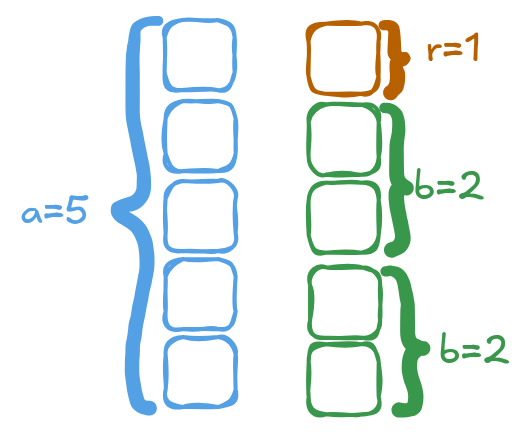
Visual Representation
This gives the following relation: \(a = bq + r\)
Euclidian Algorithm
The Euclidian algorithm is used to get the gcd (Greatest Common Divisor) \( d \) of 2 integers \( a \) and \( b \) (ie. the biggest number that divides both a and b). Also noted:
In order to find the gcd, the algorithm relies on the following claim:
If \( a \) and \( b \) are both divisible by \( d \),
then \( r \), which is equal to \( a \mod b \) is also divisible byd
but let’s prove it first, before going into the implementation of the algorithm
Approach 1: math
What we know: \( a \) and \( b \) are divisible by \( d \).
What we are trying to prove: \( r = a \mod b \) is also divisible by \( d \).
We know that if an integer \( x \) is divisible by another integer \( y \), then \( x \) can be written as \( x = ny \), where \( n \) is also an integer.
With this information, \( a \) and \( b \) could be written as:
$$ a = nd \\ b = md $$Using this and the earlier formula \(a=bq+r\), we get:
$$ r = a - bq \\ r = (nd) - (md)q \\ r = (n - mq) * d $$\( r \) is in the form of an integer \( n-mq \) times \( d \), which means \( r \) is divisible by \( d \).
Approach 2: visual intuition
In this approach, we need to think of an integer \( a \) being divisible by \( d \) as: \( a \) being made of \( n \) blocks of size \( d \):
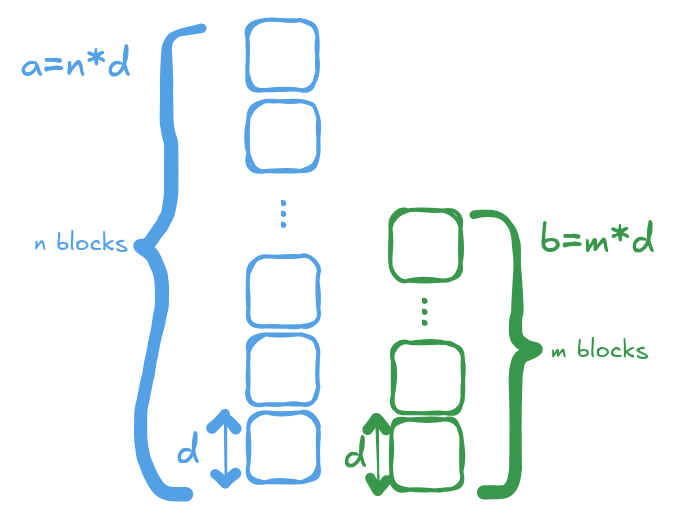
Blocks illustration
In the above figure, we see that \( a \) is made of \( n \) blocks of size \( d \) and \( b \) is made of \( m \) blocks of size \( d \). This is the same as \( a=nd \) and \( b=md \)
In this illustration, we can see that the remainder \( r \) will always be made up of a whole number of blocks of size \( d \), thus will always be divisible by \( d \). This is because \( r \) is what remains when you substract \( b \) “\( q \) times” from \( a \) (ie. \( r = a - bq \)) and since \( a \) and \( b \) are made of the same unit blocks, naturally the remainder will also be the same.
Now coming back to the Euclidian Algorithm.
We have shown that if \( a \) and \( b \) are divisible by \( d \), then \( r = a \mod b \) is also divisible by \( d \).
And we know that \( a \) and \( b \) are both divisible by \( gcd(a,b) \). So, applying what we just proved, \( r = a \mod b \) is divisible by \( gcd(a,b) \).
\( r \), being smaller than both \( a \) and \( b \), will naturally have the same gcd as them.
We can therefore write:
$$ gcd(a,b) = gcd(a,r) = gcd(b,r) $$This helps a lot in reducing the possibilities, since finding the gcd of smaller numbers is easier that of larger ones.
Implementation
The algorithm will first compute r = a % b.
If r is equal to 0, it will return min(a,b)
Else it will return gcd(min(a,b), r)
def gcd(a, b):
    r = a % b

    if r == 0:
        return min(a, b)

    return gcd(min(a, b), r)

print(gcd(12,44))
Extended Euclidian Algorithm
The extended euclidan algorithm is a way to find 2 integers \( x \) and \( y \) such that:
$$ xa + yb=gcd(a,b) $$To start, let’s look at the simplest case first: when \( r=0 \).
If we are given 2 integers \( a \) and \( b \), and \( r = a \mod b = 0 \), then the smallest among them is the gcd.
In this particular case, \( x \) would be \( 0 \) and \( y \) would be \( 1 \):
$$ 0*a+1*b=gcd(a,b)=b $$This will be the base case of the recursion.
Now let’s try to understand the different steps involved.
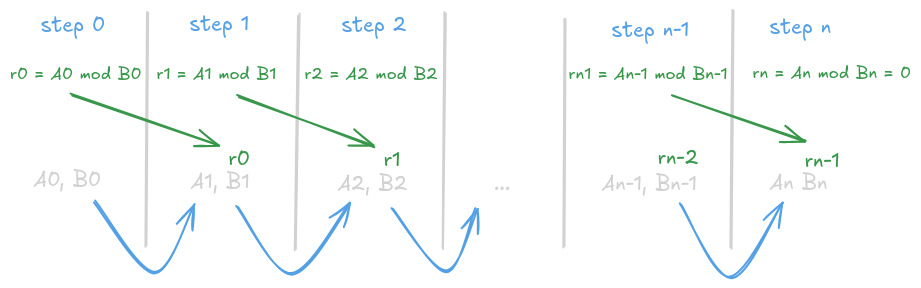
Recursion Steps
At the start, we are given 2 integers \( A_{0} \) and \( B_{0} \) (\( A_{0} \) > \( B_{0} \)) and we are trying to find:
- \( d = gcd(A_{0}, B_{0}) \)
- \( x \) and
ysuch that: \( x*A_{0} + y*B_{0} = d \)
At step 0, we compute \( r_{0} = A_{0} \mod B_{0} \), if it’s not 0 we move to step 1 with \( A_{1} = B_{0} \) and \( B_{1} = r0 \).
At step 1, we repeat the same process until we reach step n.
At step n, we compute \( r_{n} = A_{n} \mod B_{n} \) and find that it is equal to 0. We have reached the base case, so we return \( d=B_{n} \), \( x=0 \), \( y=1 \):
$$ d = B_n = 0*An + 1*B_{n} $$Then, we go back to step n-1. Here we need to recalculate \( x \) and \( y \) for \( A_{n-1} \) and \( B_{n-1} \), because the previous values we had (.ie \( x=0 \), \( y=1 \)) were for \( A_{n} \) and \( B_{n} \). For each step we need to have right values of \( x \) and \( y \), until we ultimately get back to step 0 where we’ll have the final values.
We can generalize this problem in the following manner:
Knowing the values \( x \) and \( y \) for step k, what are the values for step k-1 ?
From the arrows in the illustration above, we can see:
- \( A_k = B_{k-1} \)
- \( B_k = r_{k-1} = A_{k-1} - B_{k-1} * q_{k-1} \), (\( q_{k-1} \) being the quotient between \( A_{k-1} \) and \( B_{k-1} \))
Knowing this, we can find the new values of \( x \) and \( y \):
$$ d = xA_k + yB_k \\ d = xB_{k-1} + y r_{k-1} \\ d = xB_{k-1} + y(A_{k-1} - B_{k-1}q_{k-1}) \\ d = xB_{k-1} + yA_{k-1} - yB_{k-1}q_{k-1} \\ d = yA_{k-1} + (x - yq_{k-1})B_{k-1} $$In the end we have:
$$ x_{k-1} = y_{k} \\ y_{k-1} = x - yq_{k-1} $$Implementation
We now have everything we need to implement the algorithm.
def f(a, b):
    # Calculating the remainder
    r = a % b

    # Base case
    if r == 0:
        arr = [b, 0, 1]
        return arr

    else:
        arr = f(b, r)

        # Calculating the new values of x and y
        new_x = arr[2]
        new_y = arr[1] - arr[2] * (a//b)

        arr = [arr[0], new_x, new_y]
        return arr


a = 12
b = 44
res = f(a, b)
print(f"{res[0]} = {res[1]} * {a} + {res[2]} * {b}")